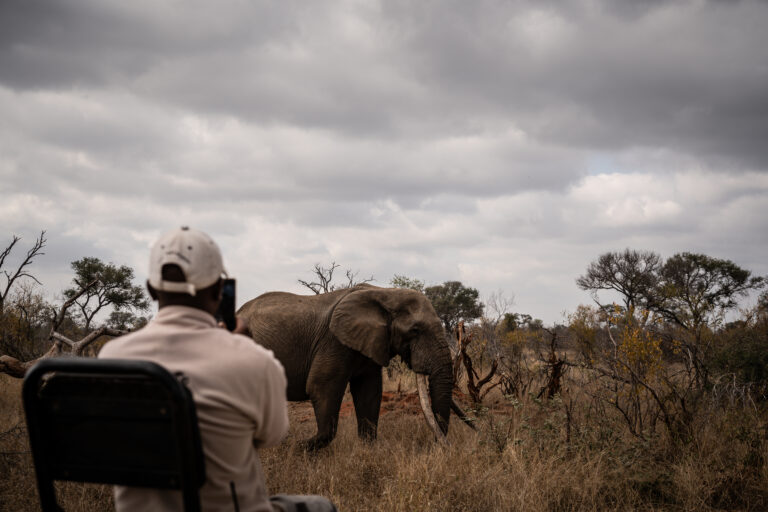
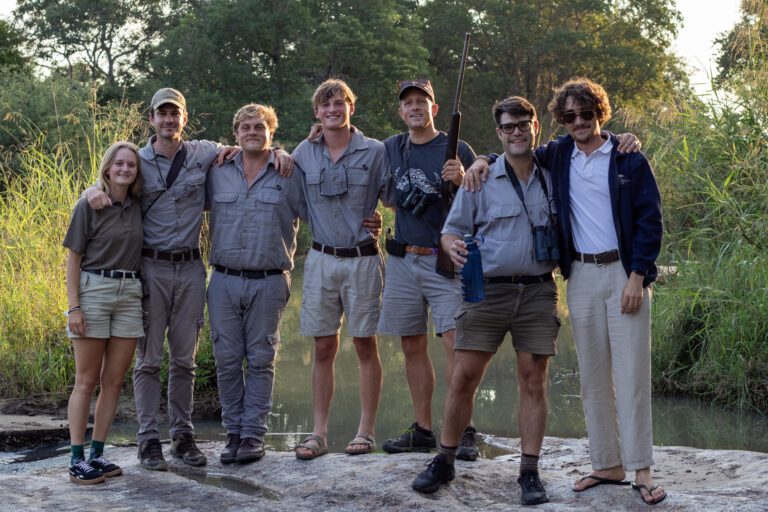
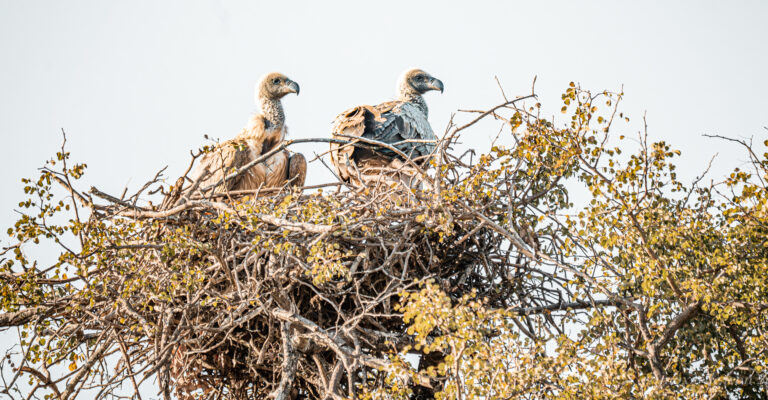
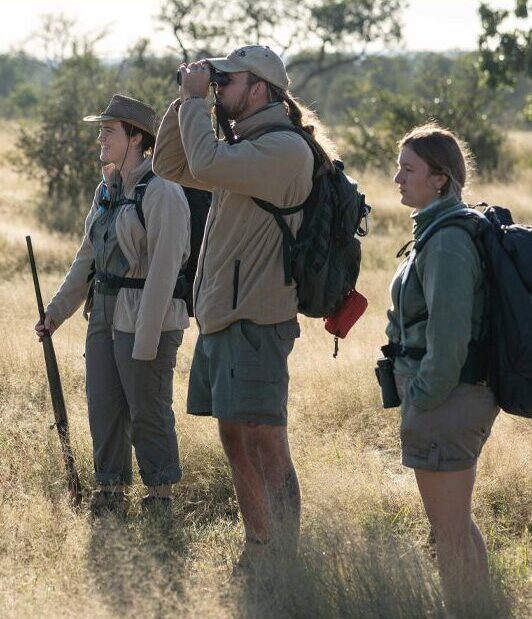
The yearlong course is designed to produce the highest-calibre guides possible, who can immediately go to work in the field. Students learn why certain insects, mammals, and birds behave in certain ways at certain times by living amongst the wildlife for the duration of the course.
This course is consisting of two parts; which comprises of approximately 4 – 5 months of theoretical and practical training with our highly qualified instructors, in which students complete various separate certified courses. Following this is the lodge placement period of between 5-6 months, which will make up the second half of the course. We place students at a lodge where they will work with experienced guides and lodge managers, where they have agreed to mentor our students and develop their newly acquired skills. At the end of the course, students are not only qualified but would also have also gained substantial working and practical experience in the industry.
Most of the students that attend this particular course, ages range from 18 to 34 and are either looking for an environmental career, safari career or a meaningful educational gap year. EcoTraining has to date trained over 11000 students overall from 33 different countries around the globe!

WHAT YOU WILL LEARN ON THE COURSE
The below table outlines the broad overview of the course modules learned on the course.
| The Introduction to Guiding in the Natural Environment | Ethics of professional Nature Guiding | Conservation and Habitat Management | Basic Bush and Survival Skills |
| Identification and ecology of invertebrates and arthropods | Mammals, reptiles, amphibians and fish | Animal Behaviour | Plant communities |
| Habitat and environments | Walking in dangerous Game Areas | Tracks and sign interpretation and Tracking | Geology and soils |
| Weather and climate | Astronomy | Plant identification and plant uses | Basic Taxonomy |
| Basic Ecology | Navigation and situational awareness | Off-Road and sensitive 4×4 Driving | Birds identification and behaviour |
| Radio Procedures | Dangerous Game Knowledge and Behaviour | Vehicle positioning for photography | Navigational hiking and wilderness sleep out |
| Rifle handling and ballistics | Trails guiding | Night drives | Anatomy and Physiology |
WHERE YOU WILL LIVE AND LEARN FROM FOR THE DURATION OF THE COURSE
EcoTraining’s courses are conducted from unfenced bush camps in wildlife reserves that have real ecological appeal, an abundance of exceptional wildlife species and biodiversity. These camps are located in South Africa, Botswana, Zimbabwe and Kenya.

Because participants are completely immersed in remote wilderness areas – it’s astonishing how it can be both quiet and loud at the same time. In the infinite stretches of grasslands and acacias, one can hear the sounds so clearly because there are no or few tourists around, no cameras clicking, and no multitudes of vehicles with radios breaking the bush sounds at dusk. Students slot into the natural environment and become one with it. Not to mention how over the first few days, their numbed basic-human senses are revived and you are able to see better, smell better and feel an improved self-awareness.
The humble comfortable camps have running hot and cold water; no electricity – lecture and dining areas that are lit with solar lanterns in the evening. There are no fans, no air conditioning, and certainly no televisions. The evenings end with students getting to know each other around a crackling campfire or slipping into their beds after some star-gazing. When they sleep they will hear the snapping of tree branches under the elephants’ mass, hyenas whooping in the distance and the nightjar birds calling close by.
CERTIFICATION AND ACCREDITATION
With a course of this depth students can expect to work hard. Our expert instructors will always make sure that students feel empowered and equipped to successfully complete their examinations.
Students who successfully pass their assessments can acquire the following certifications;
- EcoTraining Certificate of Participation
- FGASA endorsed tracking certificate
- FGASA Field Guide Level 1 (NQF2) (theory and practical)
- First Aid qualification
- FGASA Trails Guide Back Up (theory and practical)
- Firearm Proficiency Certificate
- Advanced Rifle Handling (FGASA accreditation)
- Animal Tracks and Tracking
- Basic Birding
- Advanced Birding
- Wilderness Medicine: Level 1 & 2
- Navigation and Orientation
Operating for 24 years, EcoTraining is a pioneer and leader in safari guide and wildlife training industry in Africa. This programme is built on tried and tested standards and has been designed to supply the safari industry with high-calibre FGASA (Field Guides Association of Southern African) endorsed and CATHSSETA (Culture, Art, Tourism, Hospitality and Sports Sector Education and Training Authority) accredited qualified professional field guides.
To enquire about the Professional Field Guide course email [email protected] or enquire directly on our website.