Packing lists for a bush trip usually cover the obvious: sturdy boots, neutral colours, a hat. But if you’re heading out with an EcoTraining mindset, where every walk and game drive is also a chance to learn, a few extra items can make a real difference. Let me share with you some gadgets that make learning in the bush easier and more fun, and gadgets that make camp life a little more comfortable.
For learning in the bush
Binoculars
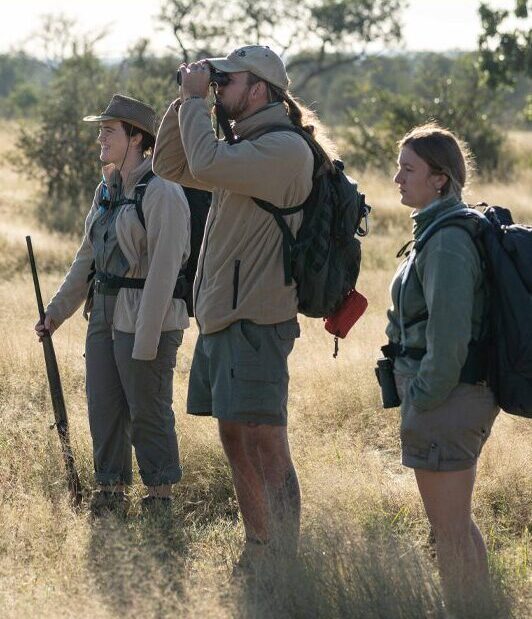
To me, binoculars are everything, my holy grail. If I forget my phone, water bottle, or sunglasses, that’s annoying. But if I forget my binoculars, I feel like only half a person.
They’re not just for spotting wildlife in the distance; they’re a genuine safety tool, letting you scan an area before you step into it on a walk. They’re also essential for identifying birds, picking up finer details, and studying animal behaviour up close. You miss so much without a closer look. Whenever people ask me what to bring to the bush, a good pair of binoculars is always at the top of my list; they’re so worth the investment. That doesn’t mean you need the most expensive model on the market; excellent mid-priced options are available, too. As for size, aim for at least 8×42. I personally prefer 10×42, a great size for birding without being too bulky to carry all day.
A field notebook (or app)
Out in the field, you’ll want to take notes, whether you’re just starting out as a safari guide student or you’ve been doing this for years (because out here, you never stop learning). Some people love a physical notebook and pen. I prefer the notes app on my phone, mainly because it lets me add photos easily – and you’ll end up taking a lot of them.
Here’s a tip: the moment you take a photo, go into editing mode and add a caption, like the name of the plant or whose track you just found. Sort these into folders: one for tracks, one for flowers, one for insects, and so on. Before long, you’ll have built yourself a beautiful little media library to come back to again and again.
Apps (and books)
Your phone can become a genuinely useful tool in the bush. I know some people want to cut down on screen time out here and enjoy a bit of a digital detox – fair enough, and reference books are great (especially for tracks, in my opinion), but sometimes you just don’t want to carry so much. I put my phone on flight mode (there’s usually no reception anyway) and, besides using it for photos and notes, I only reach for a handful of nature apps, most of which work perfectly offline. My favourites:
- Roberts Bird Guide or Firefinch for birding and practising bird calls
- eTrees of Southern Africa for identifying trees
- SkyView Lite for stargazing
- Avenza for maps
A Magnifying Glass
This one adds a little something extra to any guided experience. While studying for my NQF2, one of my trainers kept reminding me to always take it a step further. Don’t just look at something, look closer, dive in. That’s exactly what a magnifying glass lets you do. It’s brilliant for really studying plant structures or insects, and it can open up whole new worlds for you and your guests. It’s also a great trick with kids: hand them a magnifying glass on a coffee break and see what they come up with.
A Knife
Some people carry a Leatherman around the bush as if they’re about to build a house out there. In my experience, it mostly gets used to open bottles — but I’ll admit, a small knife also has real educational value. Have you ever cut open a wild flower to look at its stigma and ovaries in detail (not something to do too often, just for learning purposes), or cut a small piece off a branch to hand to a guest for a closer study? A sharp knife makes clean cuts on plant material and, of course, it’s handy for cutting up an apple when you need a snack along the way.
For making camp life more comfortable
Clothespins: Trust me on this one: you will want to hang up clothes, towels, your water bladder, and other odds and ends in front of your tent. Bringing your own clothespins (or even just a piece of rope) makes a surprising difference.
A buff: Freezing in the early morning? Pull it up over your face. Dry and dusty? It keeps you from breathing in fine particles. Hot and sweaty? It soaks it right up; you can even wet it and wrap it around your wrist to cool down. An absolute all-rounder.
A headlamp: Fumbling for your socks in a dark tent at dawn or finding your way back from the fire at night – a headlamp (or a solid torch) is essential. Not just for comfort, but for safety too.
A waterproof bag: Rain can arrive unexpectedly in the bush, and sometimes it doesn’t hold back. Especially if you’re carrying expensive gear like phones or cameras, it’s worth having somewhere to keep it dry.
Plastic zipper bags, rubber bands, and tape: For storing rubbish, carrying snacks, patching a hole, fixing a zipper, or keeping your shoes together, these little helpers have proven themselves time and again. They barely take up any space, but they can genuinely save your day.
FGASA– and CATHSSETA-qualified guiding course.
Immerse yourself in the African wilderness, expand your knowledge, and embark on a transformative learning experience with EcoTraining.
Sign up for the 28-day Trails Guide Course today!
For more information on our Career Courses, contact [email protected] or call +27 (0)13 7522532
Must Have's in the Bush | Camp Hacks
So, here you go… Here are a few essential, classic bush hacks to make your course even better.