Graduating as a Field Guide?
Possibly the very best feeling in the world!
“My assessment is an evening game drive… so I’ll head East first: better (back)light for the guests’ pictures”
“I’ll have three hours, so plan sundowners about halfway on that scenic koppie. Colleagues told me a relaxed breeding herd of elephants is hanging around there, perfect for viewing.”
“Oh, and don’t forget that one of the guests is an avid birder, so look out for feathered friends.”
All sounds like the prep work of a capable Field Guide, right? Well, that is precisely how the assessment drive at the end of an EcoTraining Practical makes you feel. Even better: it lets you BECOME a Field Guide, officially certified! And that is the best feeling in the world!
A dreaded exam?
There’s no denying it: the assessment drive is an official assessment of your skills as a guide. Fellow students act as safari guests, each with their interests and preferences (great fun to do, by the way!). But in the vehicle, you’ll also welcome a representative from FGASA, who will have a clipboard and evaluation notes. Sounds stressful? Then here’s some genuine, personal experience from both myself and my partner Sofie: the pressure doesn’t weigh up against the fantastic opportunity that the assessment drive is, and how proud it will make you feel! Our instructors told us in the early stages of the 35-day Practical: “Don’t worry about assessment. By that time, you will have learned so much about everything that you will enjoy it!” Turns out they were right. Again.
A walk in the park, then?
That would be taking it too far. I remember how focused and alert I felt when I welcomed my guests in the vehicle. Safety briefing needed to be accurate as always. Asking guests for their special interests kick-started the FGASA-man into taking notes on his clipboard and sending tingles down our spines. What will we find? What if there’s no wildlife around? And is the moon going to rise without a cloud cover?
As any Field Guide will tell you, no matter how many game drives you host, you can NOT predict what will happen. And guess what? That is precisely why this job provides the most satisfying and unforgettable experiences. After all the studying, all the practice, and so many unbelievable sightings during all those weeks in the bush, we were ready for this final challenge!
Some luck, lots of knowledge and a hint of khaki fever
What DID happen on our assessment drives? Hardly 15 minutes into mine, two Crested Francolins standing in the middle of the track refused to move, so I switched off the engine and explained a few things about these cool little bush runners. But as I was talking, I noticed how intensely focused both francolins kept staring at the roadside verge. Sure enough, the staring was replaced by a loud alarm call, and out of the grass emerged a beautiful Puff Adder! A fortunate sighting and a first for me, but also not quite planned nor expected! As the guests looked in wonder, I explained the snake’s rectilinear movement, discussed its cytotoxic venom, and added some information on how different snakes apply different hunting techniques. All the knowledge I didn’t have a month ago, but that I am now able to share as a Field Guide.
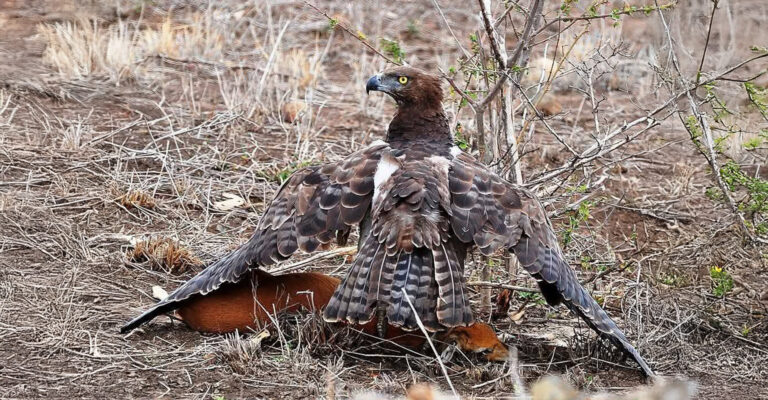
Sofie’s drive the next morning went very differently: no lucky sightings, and for a long time, animals remained hidden. But a step off the vehicle to have a closer look at tracks, fascinating stories about the cultural significance of a Buffalo Thorn and info about the impressive Northern Drakensberg on the horizon, still made for a very entertaining morning. With the drive almost at an end, she did get the chance to make the avid birder-guest happy when a magnificent Tawny Eagle posed perfectly. Not the kind of bird we had seen often during our course, nor was it quite planned or expected! But as she explained how to identify eagles from other birds of prey, how this one could grow to an impressive 15 years of age and how they are facing challenges such as habitat loss and lack of nesting sites, I found myself feeling so proud of how she too had now become a Field Guide (– confession time – I was struck by quite the case of khaki fever too!).
Life-changing?
To this day, we still struggle to describe it. We didn’t enter this course to change our careers back home. In our jobs, we have both faced quite a few challenges. We’ve given big business presentations, talked in front of press & media cameras, and we’ve organised huge corporate events. But these three hours, driving an open Land Rover, telling six guests about grasses, trees, a bird and the odd elephant. It was one of the biggest, most challenging things we ever attempted. And you know what? More than the actual NQF2 certificate, we gained something else. This course taught us to understand the bush in a much deeper way. It made us realise why we love to come and explore this magical part of the world so profoundly, time and time again. And we couldn’t have wished for a better reward than that.
Does Wim’s story sound appealing? Do you want to gain the sort of insight into the African bush that allows you to work there, or that will make any future visit there truly special? Then the EcoTraining Practical courses are for you! Have a look at the full program on the EcoTraining website and find out which one suits you best.
A FGASA and CATHSSETA-qualified guiding course.
Immerse yourself in the African wilderness, expand your knowledge, and embark on a transformative learning experience with EcoTraining.
Sign up for one of our Career Courses today!
For more information on our Career Courses, contact [email protected] or call +27 (0)13 7522532
The guided experience | Guiding 101
We are pleased to join EcoTraining Instructor Michael Anderson for the sixth episode of our popular Guiding 101 series in the guided experience. Michael and a few guests are assisting him in portraying some essential guiding skills. Together, they will show us examples of interacting with guests, keeping them interested and making them feel part of the process.