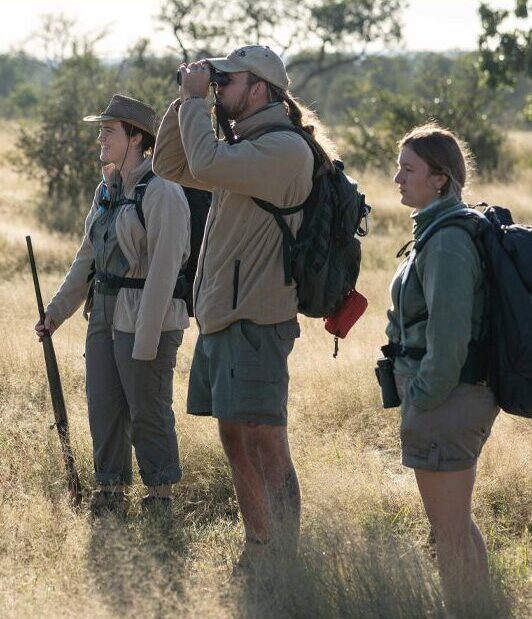
We have all been there: Signed up for a field guide course, a couple of days in, falling in love with the bush. And suddenly your instructor informs you over dinner: “From tomorrow on, it’s your turn to guide.”
Yes, this is happening, and yes, you will be okay. You’ll make mistakes, struggle with driving, and won’t be able to identify specific plants, tracks and bird calls. But you will also have the time of your life – you will learn more than you could ever imagine and develop your own guiding style while being out there in the wild.
However, where to start when you (basically) know nothing, yet? No worries, I got you covered. With these five tips, you will be well prepared to start your guiding journey.
Make a plan – and be ready to let it go.
“In the bush, anything can happen at any time” was one of the first things I learned out here. And yes, it’s true. Still, you will find yourself making a lot of plans for your game drives, wanting to take your “guests” on a great route, talk about all the interesting facts that you learned and find the perfect spot for morning coffee or a sundowner. And that is great – do your homework, always come prepared. But then be ready to do something totally different. Because special sights, road conditions or the weather can change at any time.
Make guests participate
A game drive is not a one (wo)man show, and it’s not about you showing off your skills and knowledge. Instead, you want to create an experience – together with your guests. That means you want to involve them and invite them into this beautiful, wild space. An easy way to do this is to make them use all their sense. Stop the car engine and let them listen to the bush waking up in the morning. Make them touch grasses, rocks, feathers. Give them leaves to smell, fruits to taste. And always read the room to find out what they are reacting to, what awakens their sense of wonder. And then go on a bit of an adventure together.
Tell a story
Everyone can learn information from a book and present it to their guests. Yes, some people might ask how heavy an elephant is and how fast a lion can run. However, in general, it becomes very dull very quickly when you state facts. Instead, create a storyline, talk about what you actually see in front of your eyes and then let people use their imagination. For example, People want to see a leopard, a very elusive animal that is hard to find. But you can spot their tracks, describe how a leopard may have walked here in the early morning, patrolling their territory, marking a bush, climbing up the massive sausage tree (“Can you see their claw mark on the bark?”), waiting for the perfect opportunity to jump on an impala. Nobody will care about the animal’s shoulder height, I promise.
Let your own passion guide you.
Enthusiasm is contagious. So, don’t worry if you don’t find any big mammals or a sure bird somebody was hoping for on some days – there cannot be crazy sightings anytime you go out. But the bush – with all its big and small wonders – is always there. Just look around and share whatever gets your attention. A bright blue butterfly, an impressive granite rock, the smell of the soil once the sun warms it up, the giant spider web – if you get excited about these, your guests will, too.
Always put nature first.
Whatever you do as a guide: Do it ethically. In other words, you always prioritise the animals and the ecosystem. Respect all living and non-living things around you, and ensure that your guests do the same. No touching animals, no extensive tearing out of plants (yes, for educational purposes, it’s okay to pick a flower or grab some leaves), and obviously no littering. What it really means to be an ethical guide is a matter of education and experience – and something you will learn during your time with EcoTraining.
A FGASA and CATHSSETA-qualified guiding course.
Immerse yourself in the African wilderness, expand your knowledge, and embark on a transformative learning experience with EcoTraining.
Sign up for one of our Career Courses today!
For more information on our Career Courses, contact [email protected] or call +27 (0)13 7522532
Finding freedom in the bush l Student interview with Louie Holmes
In this video, we meet Louie Holmes, an EcoTraining Professional Field Guide student who came to Africa from England. With a passion for conservation, a keen interest in animals and a prominent open and social person, spending a year in the bush sounded like an appealing adventure right up his alley. Louie discovered a lot about himself and his fellow students, who came from various parts of the world with diverse cultures and came together to live and learn in the African bush. As a naturally independent person, he knew to be even more so and found his fondness for freedom. The friendships and connections he made with his fellow students are one of the highlights for him, as well as his passion for safari walks and teaching others, which came naturally to him.